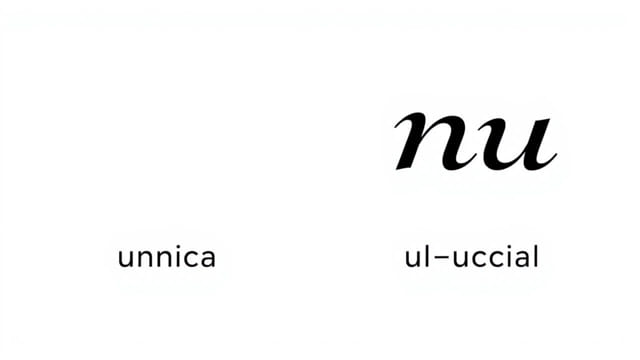
In the history of Western calligraphy and manuscript writing, the terms ‘Uncial’ and ‘Half Uncial’ refer to distinct yet related styles of script that emerged in late antiquity and developed throughout the early medieval period. These scripts played an essential role in the transmission of religious, literary, and scholarly texts across Europe. Understanding the differences between Uncial and Half Uncial is key for students of paleography, medieval history, and calligraphy. Each script carries its own stylistic characteristics, historical context, and cultural implications, making them rich subjects for exploration and comparison.
Origins and Historical Context
Uncial Script
Uncial script originated around the 3rd or 4th century AD and was primarily used in Latin and Greek manuscripts. It is often associated with the early Christian church and is known for its rounded, majuscule (uppercase) letterforms. Uncial was popularized by scribes transcribing sacred texts, such as biblical manuscripts and liturgical writings.
Its development is thought to have been influenced by Roman capital letters and cursive writing, but it adopted a softer, more rounded aesthetic, suitable for writing on parchment or vellum with a quill. Uncial script flourished from the 4th to the 8th centuries and was used across the Roman Empire and early medieval Europe, especially in religious scriptoria.
Half Uncial Script
Half Uncial, also known as Semi-Uncial, developed slightly later, around the 5th century AD. While it shares some visual characteristics with Uncial, it differs in that it incorporates more minuscule (lowercase) elements. It represents a transition between the majuscule Uncial script and the later development of fully minuscule scripts like Carolingian minuscule.
This script was favored in monastic scriptoria, particularly in regions like Ireland and Northumbria, where Insular script styles developed. Half Uncial allowed for faster writing and more compact text, which made it practical for copying lengthy manuscripts.
Visual and Structural Characteristics
Distinctive Features of Uncial
Uncial script is defined by its rounded, upright letters. The script was written with a broad-nibbed pen held at a consistent angle, which produced thick and thin strokes. Some notable visual characteristics include:
- Uniform height for all letters, giving the text a balanced and formal appearance
- Letters like ‘A’, ‘E’, ‘M’, and ‘N’ differ noticeably from their modern counterparts
- The letter ‘D’ often has a straight vertical stem and a curved bow, resembling an angular form
- The ‘G’ has a distinctive shape, often resembling a figure 8 or an uncial loop
- Spacing between letters is generally wide, enhancing legibility
Distinctive Features of Half Uncial
Half Uncial introduces more variety in letter height and incorporates ascenders and descenders, making it more visually dynamic. This shift made it closer to later minuscule scripts. Some of the script’s defining features include:
- The use of ascenders in letters like ‘b’, ‘d’, ‘h’, and ‘l’
- Descenders in letters such as ‘g’, ‘p’, and ‘q’
- Rounded and open letterforms, but with more fluidity than full Uncial
- The ‘a’ is written more like a single-story ‘a’ rather than the Roman capital
- Ligatures and connected letters appear more frequently
Functional and Aesthetic Considerations
Why Uncial Was Used
Uncial script was often chosen for its clarity and formality. It was particularly suited to religious texts because it conveyed a sense of solemnity and importance. The evenness and legibility of Uncial made it ideal for public reading, especially of sacred scriptures. Additionally, its relatively slow writing speed was not a major issue in environments focused on accuracy and reverence over speed.
Why Half Uncial Gained Popularity
As the need for more efficient writing grew, especially in monastic settings where large volumes of texts were copied, Half Uncial offered a more practical solution. Its flowing forms and integration of minuscule elements made writing faster while still maintaining readability. It also allowed for denser text, reducing the amount of vellum or parchment required. Over time, Half Uncial paved the way for regional variations and new script forms.
Cultural and Geographic Influences
Uncial in Different Regions
Though primarily a Latin script, Uncial was also used for Greek texts. In the Byzantine Empire, for example, Greek Uncial persisted longer than in the West. In Western Europe, Uncial found a stronghold in Italy and was used in illuminated manuscripts. The script’s legacy can still be seen in certain calligraphic traditions today.
Half Uncial in the Insular World
Half Uncial took on distinctive characteristics in the British Isles, particularly within the Insular script tradition. Irish and Anglo-Saxon monks adapted the script to their needs, creating variations such as Insular Half Uncial, which had unique letterforms and ornamental features. This script style is famously seen in works like the Book of Kells and the Lindisfarne Gospels.
Legacy and Influence
Uncial’s Influence on Typography
Though Uncial eventually fell out of common use by the 9th century, its influence lives on in decorative and religious typography. Some modern typefaces are modeled after Uncial forms, often used for display purposes or to evoke a historical or medieval aesthetic. It has also found a place in fantasy literature and film, where its ancient appearance is visually evocative.
Half Uncial’s Role in Script Evolution
Half Uncial is particularly important in the evolution of Western writing. It served as a bridge between all-capital scripts and the development of true lowercase writing systems. The transition from Half Uncial to Carolingian minuscule marked a major turning point in European literacy, influencing the modern alphabet used today.
Comparative Summary
While Uncial and Half Uncial are closely related, their differences are significant in terms of both appearance and function. Here is a brief comparison:
- Uncial: Majuscule script, rounded, uniform height, formal and legible, used from 4th to 8th century
- Half Uncial: Incorporates minuscule features, more fluid and practical, ascenders/descenders present, used from 5th century onward
- Uncial’s use: Primarily religious texts and formal documents
- Half Uncial’s use: Monastic and scholarly texts with an emphasis on practicality and speed
The study of Uncial and Half Uncial scripts opens a window into the rich history of written communication in Europe. These scripts not only tell us about the aesthetics of past cultures but also reveal practical concerns, such as readability, writing speed, and material constraints. From their early origins in the Roman world to their enduring legacy in calligraphy and typography, both Uncial and Half Uncial remain important milestones in the development of Western written language. Understanding their distinctions helps scholars and enthusiasts appreciate the depth and complexity of medieval manuscript traditions.


